Phrase (Basic ㊦ 271)
A negative て form of a verb.
Equivalent: Do not do something and; without doing ~
| Vnegative | ないで | |
| 話さないで | Without talking | |
| 食べないで | Without eating |
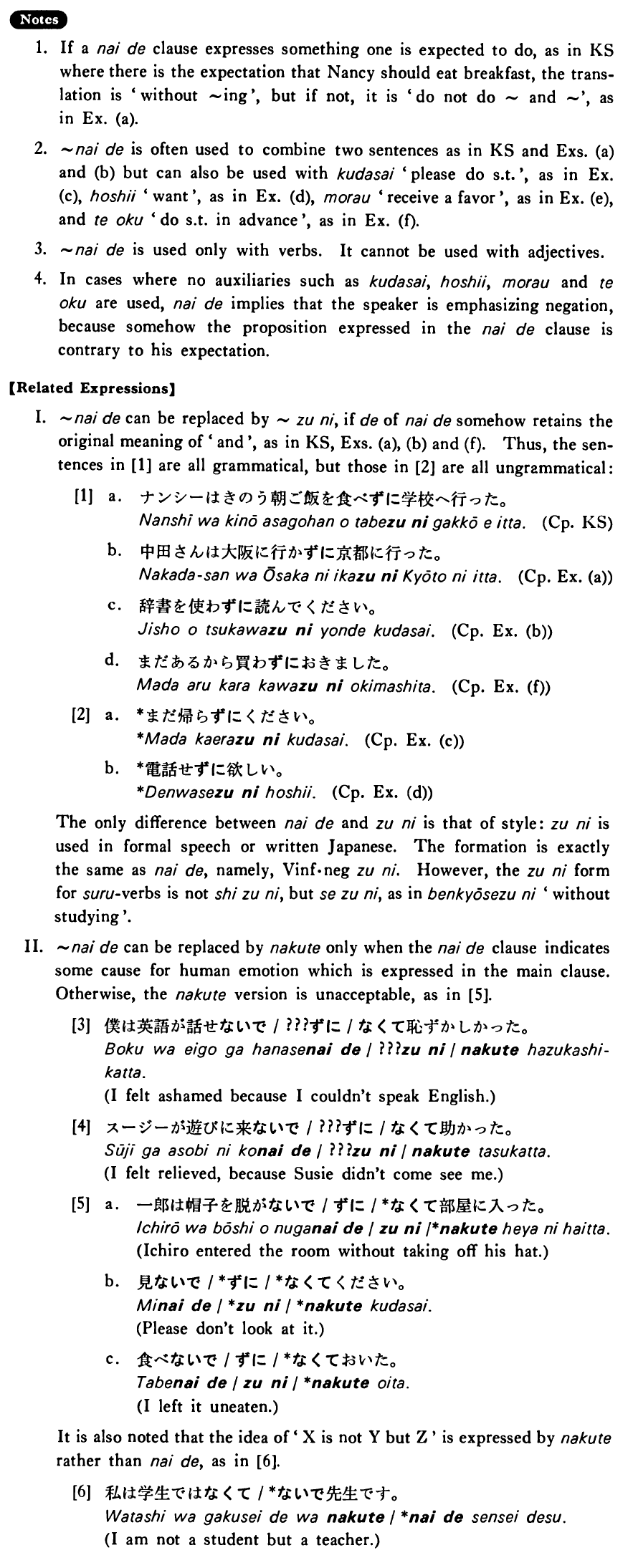
1. If a ないで clause expresses something one is expected to do, as in Key Sentence where there is the expectation that Nancy should eat breakfast, the translation is 'without ~ing', but if not, it is 'do not do ~ and ~', as in Example (a).
2. ないで is often used to combine two sentences as in Key Sentence and Examples (a) and (b) but can also be used with 下さい 'please do something', as in Example (c), 欲しい 'want', as in Example (d), もらう 'receive a favor', as in Example (e), and ておく 'do something in advance', as in Example (f).
3. ないで is used only with verbs. It cannot be used with adjectives.
4. In cases where no auxiliaries such as 下さい, 欲しい, もらう and ておく are used, ないで implies that the speaker is emphasizing negation, because somehow the proposition expressed in the ないで clause is contrary to his expectation.
【Related Expressions】
I. ないで can be replaced by ずに, if で of ないで somehow retains the original meaning of 'and' as in Key Sentence, Examples (a), (b) and (f). Thus, the sentences in [1] are all grammatical, but those in [2] are all ungrammatical:
[1]
[2]
The only difference between ないで and ずに is that of style: ずに is used in formal speech or written Japanese. The formation is exactly the same as ないで, namely, Verb informal negativeずに. However, the ずに form for する verbs is not しずに, but せずに, as in 勉強せずに, 'without studying'.
II. ないで can be replaced by なくて only when the ないで clause indicates some cause for human emotion which is expressed in the main clause. Otherwise, the なくて version is unacceptable, as in [5].
[3]
[4]
[5]
It is also noted that the idea of 'X is not Y but Z' is expressed by なくて rather than ないで, as in [6].
[6]